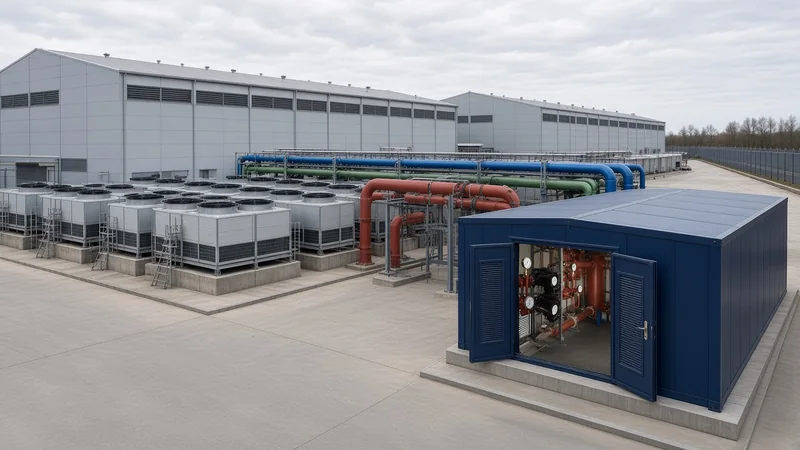
A data centre turns almost all of the electricity it uses into heat, and it does so continuously. Conventional designs reject that heat to atmosphere through chillers, dry coolers or cooling towers. Heat reuse captures some of it instead and puts it to work: heating offices on the campus, neighbouring buildings, or a district heat network.
Interest has moved from a few pioneering sites to mainstream planning discussions. This article covers why, what limits it, and what it means for the plant room.
Why heat reuse is on the agenda
- Regulation and planning. In the EU, the recast Energy Efficiency Directive introduced reporting obligations for data centres above set power thresholds, and expects larger sites to use waste heat where technically and economically feasible. In England, the Energy Act 2023 provides for heat network zoning, under which certain buildings in designated zones may be required to connect to a heat network, and large heat sources may be expected to supply one.
- Customer and investor expectations around carbon and energy reporting.
- Local authority and developer interest in low-carbon heat sources for new housing and regeneration schemes.
Requirements vary by country, site and planning consent, so the starting point for any project is to establish what applies locally.
The temperature problem
The main technical barrier is temperature. Heat from an air-cooled hall typically leaves in a return water circuit that is too cool for most heat networks or building heating systems. Two things change that:
- Heat pumps raise the temperature to what the receiving system needs. The larger the lift, the more electricity they use, so the economics depend on source and supply temperatures.
- Liquid cooling returns heat at higher temperatures than air cooling, which reduces the lift needed. See our article on direct-to-chip liquid cooling and the plant room.
Low-temperature heat networks, and buildings designed for lower flow temperatures, also narrow the gap. Matching the data centre's heat to the right customer is as important as the plant itself.
Cooling must stay the priority
A data centre operator's first obligation is to keep IT equipment within its operating envelope. Heat reuse cannot compromise that. In practice, a heat recovery design should:
- Retain full heat rejection capacity independent of the heat customer, so cooling continues if the heat network is down, in summer when demand is low, or during maintenance.
- Separate the circuits with plate heat exchangers, so a fault, leak or contamination on the heat network side cannot reach the cooling system.
- Give the cooling controls priority, with heat export treated as an opportunistic load.
- Keep heat recovery plant outside the critical redundancy calculation unless the design team decides otherwise.
What the plant room needs
A heat reuse scheme typically adds an energy centre or interface plant room between the data centre's cooling system and the heat customer. Typical elements:
- Heat recovery heat exchangers on the cooling return, with isolation and bypass.
- Water-to-water heat pumps sized to the export demand and lift.
- Buffer or thermal storage to smooth differences between continuous data centre heat and variable demand.
- Primary and secondary pumps, pressurisation and water treatment for each circuit.
- Heat metering at the boundary, for billing and reporting.
- Controls that coordinate cooling, heat pumps and export, with clear interfaces to the operator's BMS and the heat network's control system.
These elements lend themselves to prefabrication: heat exchanger and pump skids, heat pump modules, and complete packaged energy centres that can be built offsite and connected when the heat customer is ready. That also allows the scheme to be phased: provide connection points and space at day one, and install recovery plant when demand exists.
Commercial and contractual points
Technical feasibility is only half of the decision. Operators and their advisers will also need to agree:
- Who owns, operates and maintains the recovery plant and heat pumps.
- Pricing and metering of exported heat, and who pays for the electricity used for temperature lift.
- Supply obligations: whether heat is offered on a best-endeavours basis or guaranteed, and what back-up the network provides.
- Access, security and boundary arrangements for third-party staff on a secure site.
Where to start
- Establish the local regulatory and planning position, including any heat network zoning.
- Identify potential heat customers and their temperature requirements.
- Confirm return water temperatures, now and once liquid cooling is deployed.
- Reserve space and connection points in the cooling plant, even if recovery plant comes later.
- Agree the priority rules: cooling first, export second.
Treating heat reuse as an afterthought usually means retrofitting heat exchangers into a plant room with no space or isolation for them. Planned early, it can be a modest addition to the cooling design.
Planning data centre cooling plant? We design, build offsite and commission chilled-water plant rooms, pump skids and heat exchanger modules. See data centre cooling, or contact us on 07393 220694 or enquiries@prefabplant.systems via the contact page.
Published 12 November 2026 by Prefab Plant Systems, a trading name of Combicert Ltd. General guidance only; every project needs its own design.