Data centre pump skids
Pump and heat exchanger skids for data centre cooling
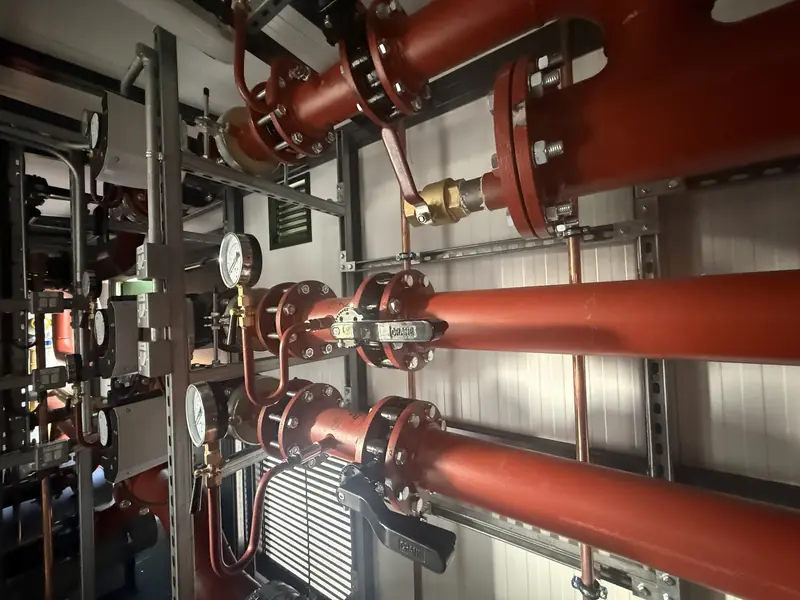
Chilled-water pump skids, technology cooling system skids and plate heat exchanger skids, fabricated offsite to the cooling design, factory tested and delivered ready to connect.
Overview
Skids built to the cooling design
A pump or heat exchanger skid puts the mechanical heart of a cooling system on one fabricated steel frame: pumps, heat exchangers, valves, strainers, instrumentation and controls, piped, wired and tested before it reaches site. On a data centre programme that means less welding and fewer trades in the hall, and plant that arrives in a known, tested condition.
We build skids to the cooling strategy set by the operator and consultant, whether the hall is air-cooled, liquid-cooled or a mix of both, and integrate with chillers, dry coolers and CDUs supplied by others.
- Sized to the access route into the building
- Repeatable for phased hall-by-hall roll-out
- Pipework cleaned, pressure tested and capped before dispatch
- Drawings, points list and test records for commissioning
Skid types
Data centre skids we build
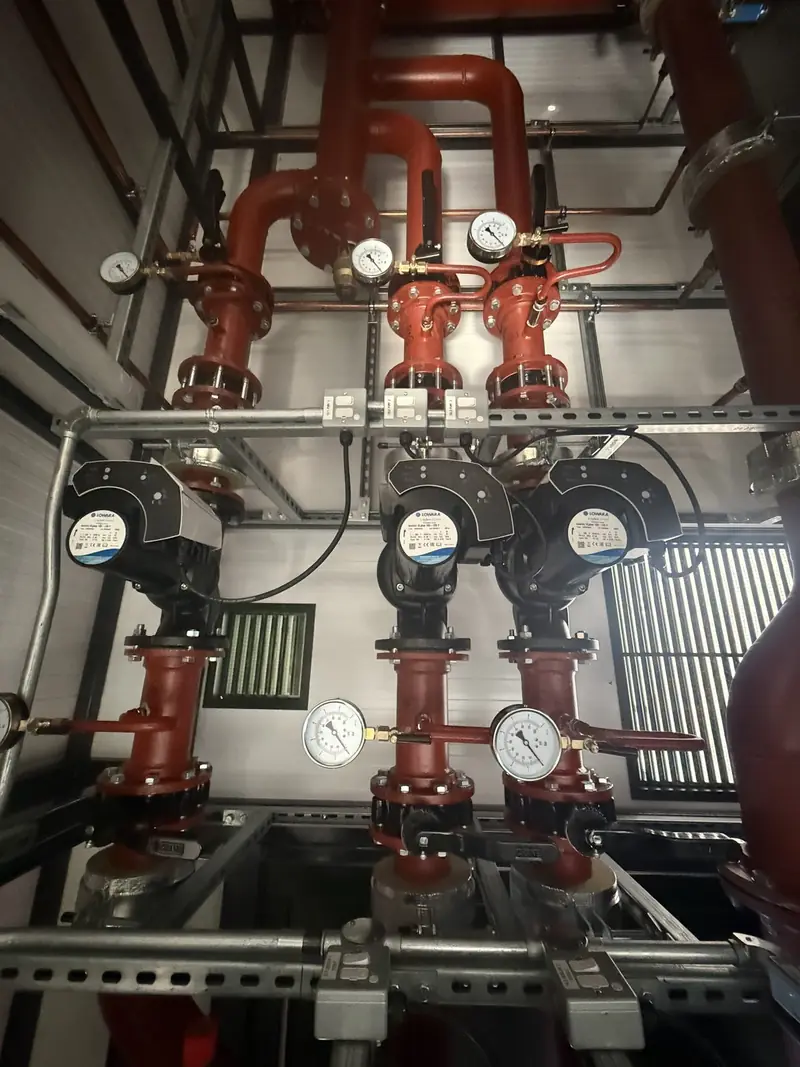
Chilled-water pump skids
Primary and secondary pumping with duty, assist and standby pumps on inverters, isolation, non-return valves, strainers and flow measurement.
TCS skids
Secondary loops serving CDUs for direct-to-chip cooling, with duty and standby fine filtration and compatible materials throughout.
Plate heat exchanger skids
Free cooling and economiser operation, and hydraulic separation between glycol and water circuits.
Pressurisation and water treatment
Pressurisation units, expansion, degassing, dosing and side-stream filtration to protect heat exchangers and cold plates.
Heat recovery skids
Heat exchanger and pump plant that takes heat from the cooling return for campus buildings or a heat network. See designing for heat reuse.
Enclosed plant modules
Pumps, heat exchangers and buffer volume inside a weatherproof enclosure, as a packaged plant room.
Resilience
Redundancy on the skid
The topology is agreed with the operator and design team before fabrication. This is how each arrangement shows up on the frame.
| Arrangement | On the skid |
|---|---|
| N+1 | One additional pump or heat exchanger on each duty set, on common headers, with automatic changeover |
| 2N | Two independent skids, A and B, each able to carry the full load |
| Concurrently maintainable | Isolation either side of each component, bypasses and access space, so any item can be removed without loss of cooling |
| Power and controls | Pumps on separately protected supplies; controls on UPS-backed supplies so flow continues through a mains failure |
| Leak detection | Drip trays and leak detection where specified, linked to the BMS or EPMS |
Testing
Factory acceptance testing
Each skid is tested in the workshop before delivery, and the client team can witness it.
- Pressure testing of all pipework, with certificates.
- Functional tests of pumps, valves, changeover and controls.
- Points-to-point checks with the BMS or EPMS points list.
- Cleanliness: flushing, capping and records ahead of connection to IT cooling.
- Dimensional checks against the general arrangement and connection schedule.
Specification
What a skid typically carries
Every skid follows the project design. This is the base we start from.
Where the plant goes into a live building, we survey the route first and split the frame with bolted joints if needed.
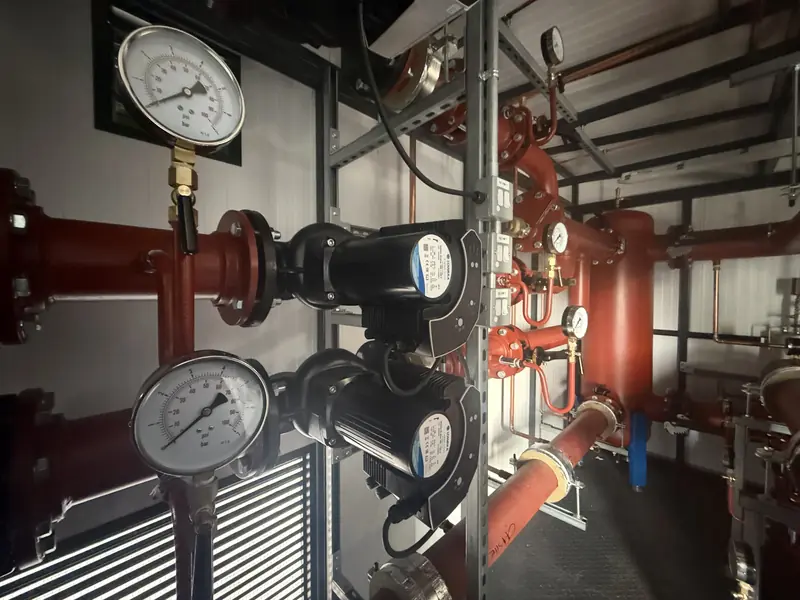
| Frame | Fabricated steel base with lifting points and forklift pockets; split sections where access requires |
|---|---|
| Pumps | Inverter-driven duty, assist and standby pumps |
| Valves | Isolation either side of each component, non-return valves, strainers, control valves to the design |
| Heat exchange | Plate heat exchangers for free cooling, separation or heat recovery |
| Instrumentation | Flow measurement, pressure and temperature sensors, energy metering where specified |
| Water quality | Filtration, degassing, dosing and pressurisation |
| Electrical and controls | Local control panel, inverters, BMS or EPMS interface |
FAQ
Data centre skid questions
Related: data centre cooling plant rooms, skid-mounted plant, and direct-to-chip liquid cooling and the plant room.
What is a TCS skid?
A technology cooling system skid serves the secondary loop that runs to coolant distribution units and cold plates in a direct-to-chip system. It carries pumps, fine filtration, pressurisation and controls, built from materials compatible with the coolant and the hardware supplier's wetted-materials list.
Do you supply the coolant distribution units?
CDUs are usually specified by the operator or hardware supplier. We build the facility-water and TCS plant that serves them, and integrate CDUs supplied by others.
Can skids be built to an operator's design standard?
Yes. We work to the employer's requirements, the consultant's specification and the operator's standards, and issue schematics, general arrangement drawings and points lists for approval before fabrication.
Can you supply repeat skids for a phased roll-out?
Yes. The same skid can be built for each hall or phase, with the same drawings, spares and operating procedures.
Will a skid fit into an existing building?
We survey door widths, corridors, lift capacities and headroom first. Skids can be split into sections with bolted joints to suit the route.
Can factory acceptance tests be witnessed?
Yes. Pressure tests, functional tests of pumps, valves and controls, and points-to-point checks with the BMS can be witnessed in the workshop before delivery.
Enquiries
Pump skids for a data hall?
Share the cooling load, redundancy target, cooling strategy and programme. We will respond with a proposed skid arrangement and next steps.